This website is intended for healthcare professionals practicing in the US.

PALYNZIQ WAS
STUDIED ACROSS
PKU AND
PATIENT TYPES

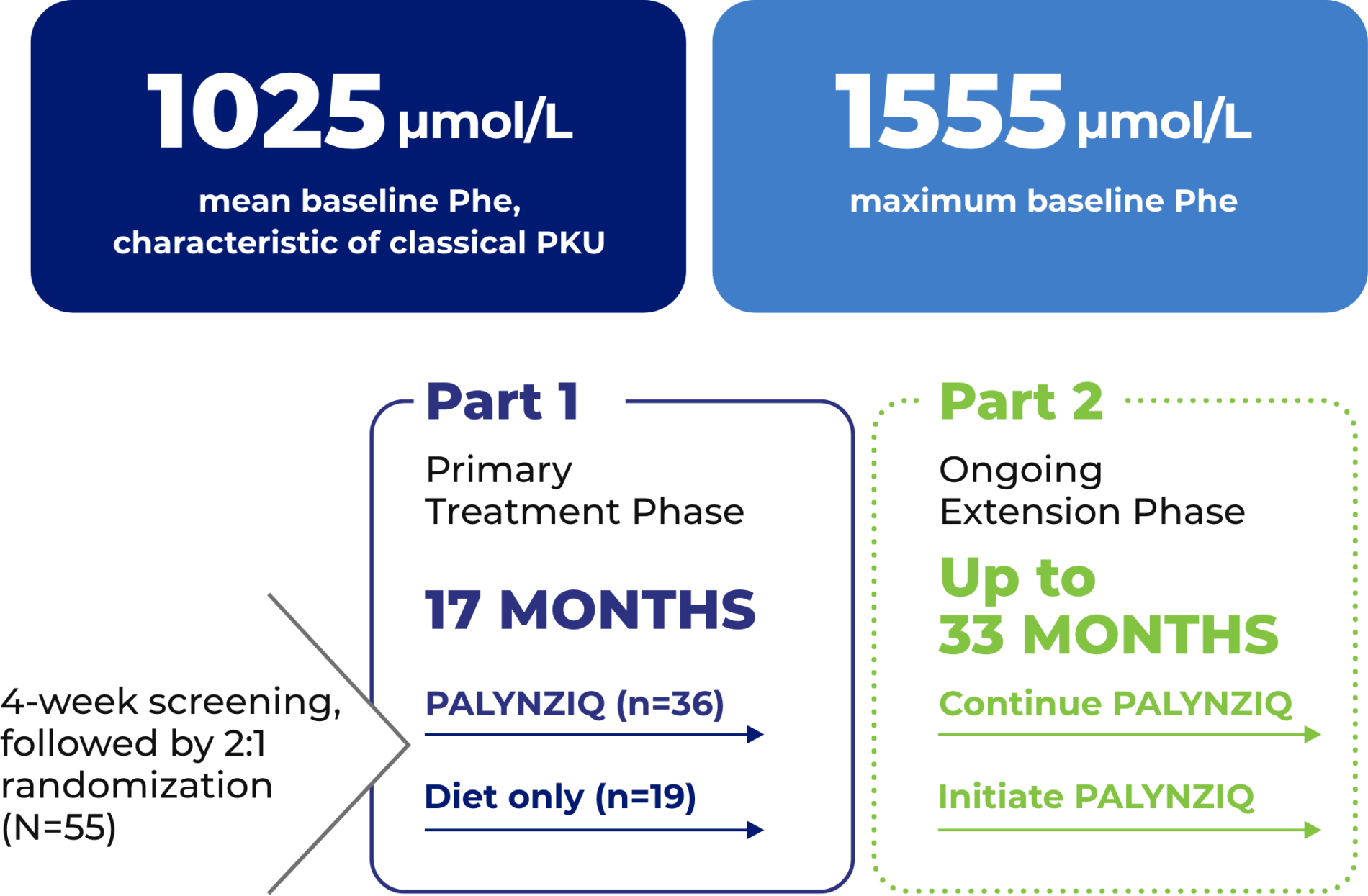
A wide range of adult patients enrolled in the PALYNZIQ® (pegvaliase-pqpz) Injection clinical trials, including those with classical or severe PKU.1,2

See PALYNZIQ clinical trial design

*The phase 3 PRISM trial for PALYNZIQ enrolled 261 individuals regardless of baseline Phe or dietary Phe restriction; adherence to existing management did not exclude participation.1
A Phe-restricted diet is defined as >75% of protein intake from medical food.1
Patients aged 16-17 years were initially included in the trial prior to a protocol amendment.2
§Patients were randomized 2:1 to either continue their randomized dosage of PALYNZIQ (20 mg or 40 mg once daily) or receive matching placebo.1,2

See results with PALYNZIQ

References: 1. PALYNZIQ [package insert]. Novato, CA: BioMarin Pharmaceutical Inc; 2025. 2. Thomas J, Levy H, Amato S, et al, for the PRISM investigators. Pegvaliase for the treatment of phenylketonuria: results of a long-term phase 3 clinical trial program (PRISM). Mol Genet Metab. 2018;124(1):27-38.doi:10.1016/j.ymgme.2018.03.006 3. Data on file. BioMarin Pharmaceutical Inc. 4. Qi Y, Patel G, Henshaw J, et al. Pharmacokinetic, pharmacodynamic, and immunogenic rationale for optimal dosing of pegvaliase, a PEGylated bacterial enzyme, in adult patients with phenylketonuria. Clin Transl Sci. 2021;14(5):1894-1905. doi:10.1111/cts.13043 5. Harding CO, Longo N, Northrup H, et al. Pegvaliase for the treatment of phenylketonuria: final results of a long-term phase 3 clinical trial program. Mol Genet Metab Rep. 2024;39:101084. doi:10.1016/j.ymgmr.2024.101084

IMPORTANT SAFETY INFORMATION

BOXED WARNING: ANAPHYLAXIS

  • Anaphylaxis has been reported after administration of PALYNZIQ and may occur at any time during treatment
  • Administer the initial dose of PALYNZIQ under the supervision of a healthcare provider equipped to manage anaphylaxis, and closely observe patients for at least 60 minutes following injection. Prior to self-injection, confirm patient’s and observer’s (if applicable) ability to recognize signs and symptoms of anaphylaxis and to administer epinephrine, if needed
  • Consider having an adult observer for patients who may need assistance in recognizing and managing anaphylaxis during PALYNZIQ treatment. If an adult observer is needed, the observer should be present during and for at least 60 minutes after PALYNZIQ administration, should be able to administer epinephrine, and call for emergency medical support upon its use
  • Prescribe epinephrine for all patients treated with PALYNZIQ. Prior to the first dose, instruct the patient and observer (if applicable) on its appropriate use. Instruct the patient to seek immediate medical care upon its use. Instruct patients to carry epinephrine with them at all times during PALYNZIQ treatment
  • PALYNZIQ is available only through a restricted program called PALYNZIQ REMS (Risk Evaluation and Mitigation Strategy). Further information, including a list of qualified pharmacies, is available at PALYNZIQREMS.com or by telephone at 1-855-758-REMS (1-855-758-7367)

WARNINGS AND PRECAUTIONS

Anaphylaxis

  • Signs and symptoms of anaphylaxis reported include syncope, hypotension, hypoxia, dyspnea, wheezing, chest discomfort/chest tightness, tachycardia, angioedema (swelling of face, lips, eyes, tongue), throat swelling or tightness, flushed or red skin, rash, urticaria, pruritus, and gastrointestinal symptoms (vomiting, nausea, diarrhea)
  • Anaphylaxis generally occurred within 1 hour after injection; however, delayed episodes occurred up to 48 hours after PALYNZIQ administration
  • Consider the risks and benefits of readministering PALYNZIQ following an episode of anaphylaxis. If the decision is made to readminister PALYNZIQ, administer the first dose under the supervision of a healthcare provider equipped to manage anaphylaxis and closely observe the patient for at least 60 minutes following the dose.
  • In clinical trials of primarily adult patients with an induction/titration/maintenance dosage regimen, 29/285 (10%) experienced a total of 42 anaphylaxis episodes.
  • In a clinical trial of patients 12 to less than 18 years of age, 4/36 (11%) of PALYNZIQ-treated patients experienced 1 episode of anaphylaxis.

Other Hypersensitivity Reactions

  • Management of hypersensitivity reactions should be based on the severity of the reaction, recurrence of the reaction, and the clinical judgment of the healthcare provider.
  • In clinical trials of primarily adult patients taking PALYNZIQ, hypersensitivity reactions, other than anaphylaxis, were reported in 204/285 (72%) of patients. In a clinical trial of patients 12 to less than 18 years old taking PALYNZIQ, these reactions were reported in 12 out of 36 (33%) of patients.

Injection Site Infections

  • Serious injection site infections including abscess, cellulitis, necrosis, and ulcer have been reported. Some cases required hospitalization, surgical debridement, intravenous antibiotics, and discontinuation of PALYNZIQ
  • Provide proper training to patients and/or caregivers on the use of aseptic injection technique, injection site rotation and to check the site for redness, swelling, or tenderness. Instruct patients to contact their healthcare provider if signs or symptoms of an infection develop, persist, or worsen.

Hypophenylalaninemia (HypoPhe)

Some patients have experienced HypoPhe; monitor blood Phe levels periodically during treatment. Frequent blood Phe monitoring is recommended in the pediatric population. For blood Phe concentrations below 30 micromol/L, the dosage of PALYNZIQ may be reduced and/or dietary protein and Phe intake may be modified to maintain blood Phe concentrations within a clinically acceptable range and above 30 micromol/L.

ADVERSE REACTIONS

The most common adverse reactions in clinical trials of primarily adult patients (at least 20% in either treatment phase) were injection site reactions, arthralgia, hypersensitivity reactions, headache, generalized skin reactions lasting at least 14 days, nausea, abdominal pain, vomiting, cough, oropharyngeal pain, pruritus, diarrhea, nasal congestion, fatigue, dizziness, and anxiety.

  • Arthralgia: In clinical trials, 245 out of 285 (86%) primarily adult patients experienced episodes consistent with arthralgia (includes back pain, musculoskeletal pain, pain in extremity, and neck pain).
  • Injection site reactions were reported as early as after the first dose of PALYNZIQ and occurred at any time during treatment.
  • Generalized Skin Reactions: In clinical trials, 134 out of 285 (47%) primarily adult patients treated with PALYNZIQ experienced generalized skin reactions (not limited to the injection site) lasting at least 14 days.
  • Angioedema and serum sickness: In clinical trials, 22 out of 285 (8%) primarily adult patients experienced 45 episodes of angioedema (symptoms included: pharyngeal edema, swollen tongue, lip swelling, mouth swelling, eyelid edema, and face edema) occurring independent of anaphylaxis. In clinical trials, serum sickness was reported in 7 out of 285 (2%) primarily adult patients.

In the clinical trials, adverse reactions were associated with treatment discontinuation, dosage reduction and temporary drug interruption. In the 285 primarily adult patients exposed to PALYNZIQ in an induction/titration/maintenance regimen in clinical trials, 44 (15%) patients discontinued treatment due to adverse reactions.

Pediatric Patients: In a clinical study of 55 patients aged 12 to less than 18 years of age, the most common adverse reactions (at least 20% and greater than in control) were injection site reactions, arthralgia, headache, pyrexia, hypersensitivity reactions, dizziness, nausea, vomiting, fatigue, and pain in extremity. Two patients (5.6%) discontinued treatment due to adverse reactions.

Blood Phenylalanine Monitoring and Diet

  • Obtain blood Phe concentrations every 4 weeks until a maintenance dosage is established. Periodically monitor blood Phe concentrations during maintenance therapy
  • Counsel patients to monitor dietary protein and Phe intake, and adjust as directed by their healthcare provider

DRUG INTERACTIONS

Effect of PALYNZIQ on Other PEGylated Products

  • In a single-dose study of PALYNZIQ in adult patients with PKU, two patients receiving concomitant injections of medroxyprogesterone acetate suspension (a formulation containing PEG 3350) experienced a hypersensitivity reaction. One of the two patients experienced anaphylaxis
  • The clinical effects of concomitant treatment with different PEGylated products are unknown. Monitor patients treated with PALYNZIQ and concomitantly with other PEGylated products for hypersensitivity reactions including anaphylaxis

USE IN SPECIFIC POPULATIONS

Pregnancy and Lactation

Available data do not establish an increased risk of adverse developmental outcomes to the fetus exposed to PALYNZIQ.

  • Advise women who are exposed to PALYNZIQ during pregnancy or who become pregnant within one month following the last dose of PALYNZIQ that there is a pregnancy surveillance program that monitors pregnancy outcomes. Healthcare providers should report PALYNZIQ exposure and encourage these patients to report their pregnancy to BioMarin (1-866-906-6100)
  • Monitor blood Phe levels in breastfeeding women treated with PALYNZIQ to ensure maintenance of blood Phe <360 micromol/L. Adjust dosage and/or dietary protein and Phe intake as needed to avoid concentrations below 30 micromol/L

Pediatric & Geriatric Use: The safety and effectiveness of PALYNZIQ in pediatric patients from birth to less than 12 years have not been established. Clinical studies of PALYNZIQ did not include patients aged 65 years and older.

You are encouraged to report suspected adverse reactions to BioMarin at 1-866-906-6100, or to the FDA at 1-800-FDA-1088 or www.fda.gov/medwatch.

Please see full Prescribing Information, including BOXED WARNING, and the Medication Guide.

INDICATION

PALYNZIQ® (pegvaliase-pqpz) is a phenylalanine (Phe)-metabolizing enzyme indicated to reduce blood Phe concentrations in adult and pediatric patients 12 years of age and older with phenylketonuria (PKU) who have uncontrolled blood Phe concentrations greater than 600 micromol/L (10 mg/dL) on existing management.